
Skimming là gì? Cách áp dụng Skimming trong bài thi Reading
Trong các bài thi đọc hiểu tiếng Anh như VSTEP, IELTS hay TOEIC, thí sinh thường gặp khó khăn lớn nhất là thiếu thời gian vì khối lượng văn bản dài. Chính vì vậy, việc nắm vững kỹ năng skimming là gì và cách áp dụng vào bài thi là vô cùng quan trọng. Cùng VSTEP E-Learning tìm hiểu ngay trong bài viết dưới đây nhé!
Skimming là gì? Lợi ích của Skimming trong bài thi Reading
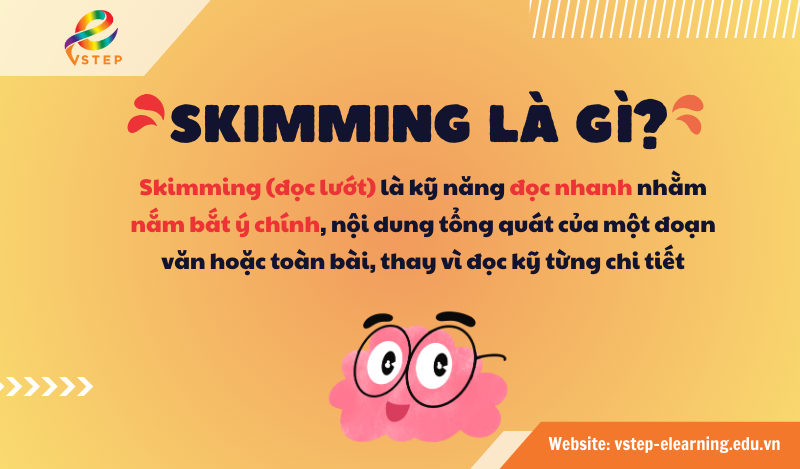
Skimming (đọc lướt) là kỹ năng đọc nhanh nhằm nắm bắt ý chính, nội dung tổng quát của một đoạn văn hoặc toàn bài, thay vì đọc kỹ từng chi tiết. Khi skimming, người đọc không tập trung vào từ vựng khó hay thông tin nhỏ lẻ mà chú ý đến cấu trúc và thông điệp chính của văn bản.
Trong bài thi Reading, skimming mang lại nhiều lợi ích quan trọng:
- Giúp thí sinh hiểu nhanh chủ đề và hướng triển khai của bài đọc
- Tiết kiệm thời gian, tránh đọc lan man từng dòng
- Hỗ trợ hiệu quả cho các dạng câu hỏi như matching headings, chọn ý chính, xác định nội dung đoạn văn
- Tạo nền tảng để kết hợp với kỹ năng scanning khi tìm thông tin chi tiết
Phân biệt Skimming và Scanning chi tiết
Mặc dù thường được nhắc đến cùng nhau, skimming và scanning là hai kỹ năng đọc khác nhau, mỗi kỹ năng phục vụ một mục đích riêng trong quá trình làm bài Reading. Việc hiểu rõ sự khác biệt giữa hai kỹ năng này giúp thí sinh sử dụng đúng phương pháp ở từng bước làm bài.
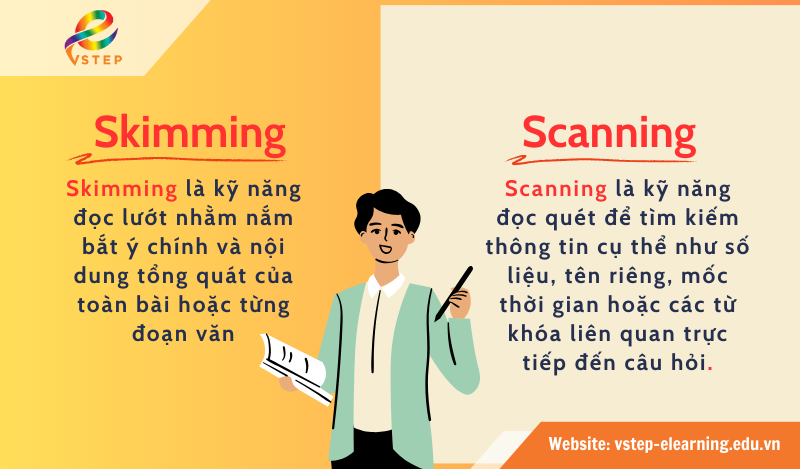
Skimming là kỹ năng đọc lướt nhằm nắm bắt ý chính và nội dung tổng quát của toàn bài hoặc từng đoạn văn. Trong khi đó, scanning là kỹ năng đọc quét để tìm kiếm thông tin cụ thể, chẳng hạn như số liệu, tên riêng, mốc thời gian hoặc các từ khóa liên quan trực tiếp đến câu hỏi.
Trong thực tế khi làm bài thi Reading, thí sinh thường áp dụng hai kỹ năng này theo trình tự hợp lý: trước tiên skimming để hiểu bố cục và ý chính của bài đọc, sau đó scanning để xác định chính xác thông tin cần thiết cho từng câu hỏi. Việc kết hợp linh hoạt skimming và scanning không chỉ giúp tiết kiệm thời gian mà còn nâng cao đáng kể độ chính xác khi làm bài.
Cách áp dụng Skimming vào bài thi Reading
Tập trung vào tiêu đề, đề mục và câu chủ đề
Khi đọc lướt, bạn nên luôn chú ý đến tiêu đề bài đọc, các đề mục (nếu có) và câu chủ đề của từng đoạn văn. Đây là những phần thể hiện rõ nhất ý chính của đoạn hoặc toàn bài. Việc đọc kỹ những phần này giúp bạn nhanh chóng hình dung được nội dung tổng quát mà không cần đọc toàn bộ văn bản.
Đọc câu đầu và câu cuối của mỗi đoạn văn
Một kỹ thuật skimming rất phổ biến là chỉ đọc câu đầu tiên hoặc câu đầu và câu cuối của đoạn văn. Trong hầu hết các bài đọc học thuật, câu đầu thường giới thiệu ý chính, còn câu cuối có thể tóm tắt hoặc mở rộng vấn đề. Nhờ đó, bạn vẫn nắm được nội dung chính của đoạn mà không mất nhiều thời gian.
Ví dụ: nối đoạn văn sau với các tiêu đề bằng cách đọc câu đầu và câu cuối của mỗi đoạn:
A There are now over 700 million motor vehicles in the world – and the number is rising by more than 40 million each year. The average distance driven by car users is growing too – from 8km a day per person in western Europe in 1965 to 25 km a day in 1995. This dependence on motor vehicles has given rise to major problems, including environmental pollution, depletion of oil resources, traffic congestion and safety.
B While emissions from new cars are far less harmful than they used to be, city streets and motorways are becoming more crowded than ever, often with older trucks, buses and taxis which emit excessive levels of smoke and fumes. This concentration of vehicles makes air quality in urban areas unpleasant and sometimes dangerous to breathe. Even Moscow has joined the list of capitals afflicted by congestion and traffic fumes. In Mexico City, vehicle pollution is a major health hazard.
C Until a hundred years ago, most journeys were in the 20km range, the distance conveniently accessible by horse. Heavy freight could only be carried by water or rail. Invention of the motor vehicle brought personal mobility to the masses and made rapid freight delivery possible over a much wider area. In the United Kingdom, about 90 per cent of inland freight is carried by road. The world cannot revert to the horse-drawn wagon. Can it avoid being locked into congested and polluting ways of transporting people and goods?
D In Europe most cities are still designed for the old modes of transport. Adaptation to the motor car has involved adding ring roads, one-way systems and parking lots. In the United States, more land is assigned to car use than to housing. Urban sprawl means that life without a car is next to impossible. Mass use of motor vehicles has also killed or injured millions of people. Other social effects have been blamed on the car such as alienation and aggressive human behaviour.
E A 1993 study by the European Federation for Transport and Environment found that car transport is seven times as costly as rail travel in terms of the external social costs it entails – congestion, accidents, pollution, loss of cropland and natural habitats, depletion of oil resources, and so on. Yet cars easily surpass trains or Academic Reading sample task – Identifying information buses as a flexible and convenient mode of personal transport. It is unrealistic to expect people to give up private cars in favour of mass transit.
F Technical solutions can reduce the pollution problem and increase the fuelled efficiency of engines. But fuel consumption and exhaust emissions depend on which cars are preferred by customers and how they are driven. Many people buy larger cars than they need for daily purposes or waste fuel by driving aggressively. Besides, global car use is increasing at a faster rate than the improvement in emissions and fuel efficiency which technology is now making possible.
G Some argue that the only long-term solution is to design cities and neighbourhoods so that car journeys are not necessary – all essential services being located within walking distance or easily accessible by public transport. Not only would this save energy and cut carbon dioxide emissions, it would also enhance the quality of community life, putting the emphasis on people instead of cars. Good local government is already bringing this about in some places. But few democratic communities are blessed with the vision – and the capital – to make such profound changes in modern lifestyles.
H A more likely scenario seems to be a combination of mass transit systems for travel into and around cities, with small ‘low emission’ cars for urban use and larger hybrid or lean burn cars for use elsewhere. Electronically tolled highways might be used to ensure that drivers pay charges geared to actual road use. Better integration of transport systems is also highly desirable – and made more feasible by modern computers. But these are solutions for countries which can afford them. In most developing countries, old cars and old technologies continue to predominate.
i. The rapid global growth of car use and its consequences
ii. Air pollution caused by traffic in major cities
iii. The historical shift to motor vehicles and its challenges
iv. Social and urban problems created by widespread car use
v. The true economic cost of car transport
vi. Limits of technological solutions to traffic pollution
vii. Redesigning cities to reduce dependence on cars
viii. A mixed transport solution for the future
A – i, B – ii, C – iii, D – iv, E – v, F – vi, G – vii, H – viii
>> Xem thêm:
Skimming phần mở đầu và kết luận của toàn bài
Đối với các câu hỏi yêu cầu xác định ý chính của toàn bài, bạn nên áp dụng skimming bằng cách đọc đoạn mở đầu và đoạn kết luận. Hai đoạn này thường thể hiện rõ: vấn đề được đưa ra và quan điểm hoặc giải pháp được đề xuất
Ví dụ:
A There are now over 700 million motor vehicles in the world – and the number is rising by more than 40 million each year. The average distance driven by car users is growing too – from 8km a day per person in western Europe in 1965 to 25 km a day in 1995. This dependence on motor vehicles has given rise to major problems, including environmental pollution, depletion of oil resources, traffic congestion and safety.
→ Đoạn mở đầu (A) nêu thực trạng gia tăng phương tiện và các hệ lụy nghiêm trọng.
H A more likely scenario seems to be a combination of mass transit systems for travel into and around cities, with small ‘low emission’ cars for urban use and larger hybrid or lean burn cars for use elsewhere. Electronically tolled highways might be used to ensure that drivers pay charges geared to actual road use. Better integration of transport systems is also highly desirable – and made more feasible by modern computers. But these are solutions for countries which can afford them. In most developing countries, old cars and old technologies continue to predominate.
→ Đoạn kết luận (H) đề cập đến các giải pháp khả thi kết hợp phương tiện công cộng và công nghệ mới.
Chỉ với hai đoạn này, người đọc đã có cái nhìn tổng quan về toàn bộ bài đọc.
>> Xem thêm: 8 Mẹo thi Reading VSTEP giúp thí sinh đạt điểm cao
Nếu bạn đang gặp khó khăn với kỹ năng Reading hoặc chưa biết cách kết hợp skimming và scanning hiệu quả, các khóa học VSTEP E-Learning sẽ giúp bạn hiệu quả trong việc nâng cao kiến thức và chiến lược làm bài từ cơ bản đến nâng cao. Đăng ký ngay hôm nay để nhận tư vấn miễn phí về lộ trình học và ôn luyện hiệu quả nhất!

>> Tham khảo thêm các khóa ôn luyện VSTEP online nổi bật:
- Khóa luyện mất gốc Online – Luyện thi Vstep
- Khóa luyện thi A1 – B1 Online có giáo viên dạy kèm
- Khóa luyện A1 – B2 online
- Khóa luyện đề B2 online
Tổng kết
Tóm lại, skimming là gì không chỉ đơn thuần là đọc lướt mà còn là kỹ năng then chốt giúp thí sinh nắm nhanh ý chính và cấu trúc tổng thể của bài Reading. Khi hiểu rõ bản chất và lợi ích của skimming, người học sẽ biết cách phân biệt và kết hợp linh hoạt giữa skimming và scanning để xử lý câu hỏi hiệu quả hơn. Việc áp dụng skimming đúng kỹ thuật, từ đọc tiêu đề, câu chủ đề đến đoạn mở đầu – kết luận, giúp tiết kiệm thời gian và giảm áp lực phòng thi. Điền ngay thông tin để được xây dựng lộ trình học cá nhân hóa!


BÀI VIẾT LIÊN QUAN
VSTEP Speaking Part 3: Cập nhật đề thi và hướng dẫn làm bài
Công phá VSTEP Writing Task 2 theo dạng bài hay gặp
Chinh phục VSTEP Writing Task 1 theo dạng phổ biến
Remember to V hay Ving? Cách dùng và bài tập
Regret to V hay Ving: Phân biệt cách dùng và bài tập
Refuse to V hay Ving? Sự khác nhau Refuse và Deny